

Montenegro €/m² at a glance
Ulcinj
Budva
per m²
Budva, per m²
As of 2026, standard coastal apartments in Montenegro range from about €1,800 per m² in Ulcinj to €2,700–4,000 per m² in Budva and Tivat, with luxury branded residences reaching €10,000 per m². Bar is the value market at €2,400–3,100 per m². Rental yields vary too much by property and letting model for one coast-wide figure; see our rental yield guide for how to estimate gross and net yield. This page sets out what each coastal municipality costs per square metre, how those figures compare with official state statistics, and what you pay on top of the purchase price.
Montenegro property prices by region (2026)
| Region | Standard apartments (€/m²) | Premium / branded (€/m²) | Our listings: median apartment (€/m², Oct 2026) | Note |
|---|---|---|---|---|
| Budva | €2,700–4,000 | €5,000–10,000 | €3,557 (102 listings) | Most active market; incl. Bečići & Rafailovići |
| Tivat | €2,700–4,000 | €5,000–8,000 (Porto Montenegro) | €6,162 (28 listings) | Porto Montenegro and Luštica Bay lift our median; closest to the airport |
| Kotor | €2,500–3,800 (Boka Bay) | €3,500–6,000 (UNESCO Old Town) | €3,484 (6 listings) | Heritage supply-constrained |
| Bar | €2,400–3,100 | €3,500–4,500 | €2,428 (60 listings) | About 30% below Budva for apartments in our listings |
| Herceg Novi | €2,400–3,800 | — | €2,964 (11 listings) | Longer season (mild microclimate) |
| Ulcinj | €1,800–2,800 | — | €2,425 (3 listings) | Most affordable coast |

Budva remains the deepest and most liquid market on the coast. Volume is concentrated in Bečići and Rafailovići, where the beach strip supports the strongest summer rental demand in the country. Because turnover is high, Budva is also where asking prices adjust fastest in either direction — see current apartments for sale in Budva.
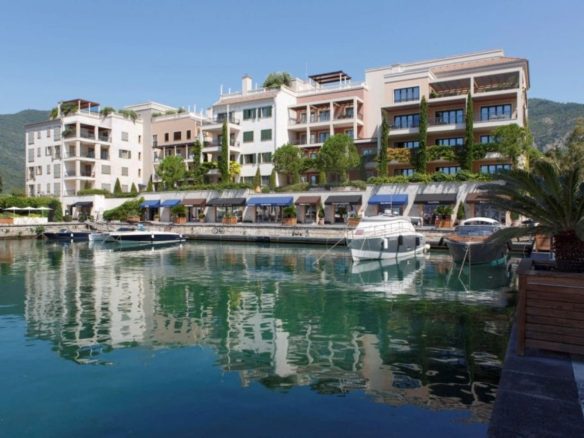
Tivat trades at similar headline levels to Budva but for different reasons. Porto Montenegro anchors the top of the market, and Tivat is the closest coastal town to the airport, which matters to buyers who fly in often. browse Tivat apartments.
Kotor behaves unlike anywhere else on the coast. UNESCO protection of the Old Town caps new supply almost completely, so heritage stock is priced on scarcity rather than yield. Boka Bay property outside the walls is materially cheaper than inside them. See property in Kotor.

Bar, Herceg Novi and Ulcinj are where the value sits. Bar apartments sit about 30% below Budva per m² in our listings (median €2,428 against €3,557, October 2026). Herceg Novi’s mild microclimate gives it a longer letting season than the central coast, and Ulcinj remains the cheapest entry point to the Montenegrin coast. Compare houses in Bar, Herceg Novi apartments and Ulcinj real estate. For a side-by-side of the three biggest markets, read our Budva vs Tivat vs Bar comparison.
How these figures compare with official statistics
The ranges above are agency transaction and listing data covering both resale and new build in specific coastal towns. The state statistics office, MONSTAT, publishes a narrower quarterly series: only newly built dwellings sold for the first time, averaged by region rather than by town.
In its latest release, published on 20 August 2026 and covering the first quarter of 2026, MONSTAT reported an average of €2,575 per m² for the coastal region, against €2,445 per m² for Montenegro as a whole, €2,395 in Podgorica and €1,708 in the north. There were no recorded new-build sales in the central region. The figures are in the official release, Prices of dwellings in new residential buildings, Q1 2026, with methodology on the MONSTAT series page.
That comparison is unusually direct, because MONSTAT defines its coastal region as exactly the six municipalities in the table above — Bar, Budva, Herceg Novi, Kotor, Tivat and Ulcinj. So €2,575 per m² is the official new-build average across the same six towns, and it lands just inside the bottom of our standard band. That is what you would expect rather than a contradiction: MONSTAT counts first sales only, averages the cheaper and dearer municipalities together, and excludes both the resale market and the premium segment where most international buyers transact.
The direction of travel is the more useful signal. The national new-build average has risen from €1,756 per m² in Q1 2024 to €2,445 in Q1 2026 — up about 39% in two years, with the steepest single step between Q3 and Q4 2025. Read the two sources together: MONSTAT tells you where the new-build market is heading, and the table above tells you what a specific apartment in a specific town is likely to cost today. Our wider dataset is summarised on the Montenegro real estate statistics page.
What you pay on top of the purchase price
The headline €/m² is not the total. Montenegro replaced its flat 3% transfer tax with a progressive scale on 1 January 2024, and new build is treated differently from resale.
| Cost | Amount (2026) | Paid by |
|---|---|---|
| Property transfer tax (resale) | 3% up to €150,000; 5% from €150,001–€500,000; 6% above €500,000 | Buyer |
| New build bought from the developer | No transfer tax — 21% VAT applies instead, usually already inside the asking price | Buyer |
| Annual property tax | 0.25%–1% of the tax-assessed value per year, set by the municipality | Owner |
| Notary fees | Set by the official notary tariff; ask for a quote | Buyer |
| Buyer agent commission | 0% at Montenegro Estates | — |
| Building maintenance | ~€20–80 / month | Owner |
| Capital gains tax (on resale) | Applies on profit when you later sell | Seller |
Because the transfer tax is banded, the effective rate rises with price rather than jumping. On a €300,000 resale apartment you pay 3% on the first €150,000 and 5% on the next €150,000 — €12,000 in total, an effective 4.0%. On a €600,000 resale the bill is €4,500 + €17,500 + €6,000 = €28,000, an effective 4.7%. Only the slice above €500,000 is ever charged at 6%.
Always confirm with the developer whether a new-build price is quoted inclusive of VAT before signing a reservation — practice is not uniform. Our full breakdown lives on the cost of buying property in Montenegro, and the trade-offs between the two routes are covered in resale vs new build and new builds in Montenegro.
What drives the gap between towns
Four factors explain most of the spread in the table.
- Season length. Rental income is concentrated in May–September, and July–August rates run two to three times shoulder season. Towns with a longer usable season, such as Herceg Novi, hold value better outside summer.
- Airport access. Being close to Tivat airport matters to buyers who travel often and to holiday lets with short stays.
- Supply constraints. Kotor’s UNESCO status effectively freezes new supply inside the Old Town. Where new stock cannot be built, price is set by scarcity.
- Distance from the beach. A few hundred metres inland routinely changes the rate per square metre more than the town name does.

What could move prices next?
We do not publish a growth rate per town: our listing data shows asking prices, not completed sales, so it cannot measure appreciation reliably. The argument most often made for the whole coast is EU accession, but it is not a guarantee: Croatian house prices fell in the years around its 2013 accession. We set out that case, with the caveats, in our EU accession and property analysis. At the top of the market, supply of genuinely branded product remains thin — see luxury property in Montenegro.
Key facts
- Bar apartments are about 30% cheaper per m² than Budva in our listings (the older “50% cheaper” figure is outdated).
- Peak rental season is May–September; July–August rates run 2–3× shoulder season.
- Standard purchases complete in 30–45 days; cash deals can close in as little as 2 days.
- Renovation costs: €300–600/m² standard, €800–1,200/m² high-end.
Frequently asked questions
What is the average price per square metre in Montenegro?
For newly built dwellings, MONSTAT reported €2,445 per m² nationally in Q1 2026 and €2,575 per m² across the six coastal municipalities. On the coast in practice, standard apartments run €1,800–4,000 per m² depending on town, and premium or branded residences reach €10,000 per m².
Which is the cheapest coastal town in Montenegro?
Ulcinj, at roughly €1,800–2,800 per m² for standard apartments. Bar is the next step up at €2,400–3,100 per m² and has been appreciating faster.
Can foreigners buy property in Montenegro?
Foreign buyers can generally own apartments and houses, subject to statutory exceptions. Article 415 restricts foreign ownership of agricultural land, forests and forest land, natural resources, public-use property, certain protected cultural monuments, islands, the one-kilometre land-border zone and designated security areas. A foreign individual may exceptionally acquire up to 5,000 m² of agricultural or forest land when the transaction includes a residential building on that land. Check the specific property’s status before buying; a company is not a universal workaround.
How much tax do I pay when buying?
On a resale, transfer tax is banded at 3% up to €150,000, 5% from €150,001 to €500,000 and 6% above €500,000, so a €300,000 purchase costs €12,000 in tax and a €600,000 purchase €28,000. On a new build bought from the developer there is no transfer tax; 21% VAT applies instead and is usually already included in the price.
Do you need a lawyer to buy property in Montenegro?
No — hiring a lawyer is optional in Montenegro, not legally required. Most foreign buyers complete a purchase using a licensed estate agent plus a notary, who verifies ownership and registers the transfer. A lawyer is worth engaging mainly for company purchases, inheritance sales, or transactions above €500,000.
Does buying property give residency in Montenegro?
For property-based temporary residence, the applicant must own at least half of the property. Where the value requirement applies, the tax-assessed value must be at least €150,000. This value requirement does not apply to EU citizens and their family members, or citizens of Iceland, Liechtenstein, Norway and Switzerland. Other residence conditions still apply. Existing property-based permits issued before the 2026 amendment took effect have transitional renewal rules under Article 217b. See the detailed property residence guide.
Montenegro Property Residency 2026 Guide
What rental yield can I expect?
It depends on the property, the location and how it is let, so we do not quote one coast-wide figure. Income is concentrated in the May–September season, and net income depends on management, maintenance, tax and how much of the shoulder season you can fill. Our rental guide walks through the costs and tax involved.
Standard and premium ranges reflect Montenegro Estates’ listing data and market experience across coastal municipalities, expressed as ranges per square metre. The median column is calculated from our listings for sale on 13 October 2026 (apartments with a stated floor area, by municipality; Kotor and Ulcinj are small samples). Luxury and Old Town segments are listed separately. Official comparison figures are MONSTAT, Q1 2026 release of 20 August 2026, newly built dwellings sold for the first time. Tax bands current as at the 2024 progressive transfer tax reform. Last reviewed: 13 October 2026.